Image

R&D as a Driver for Accelerating Innovation
From Concept to Serial Production

Research and development (R&D) is the starting point of innovation. Yet many projects that start with a promising concept lose time and predictability on the way to production. In this article, we explain how a structured R&D approach reduces technical risk, accelerates decision-making and creates a clear path from concept to serial production.

What is the role of R&D in innovation?

R&D is often seen as the phase in which new ideas are explored, technologies are evaluated and concepts are turned into tangible solutions. In practice, R&D does much more. It plays a critical role in proactive risk assessment, in validating technical feasibility and in defining a clear path from concept to implementation.

Without a structured R&D approach, unexpected risks slow down the innovation process and make the outcome unpredictable and difficult to scale. Effective R&D combines technical expertise with a structured method, so that ideas evolve into feasible and scalable solutions.

A structured approach to R&D

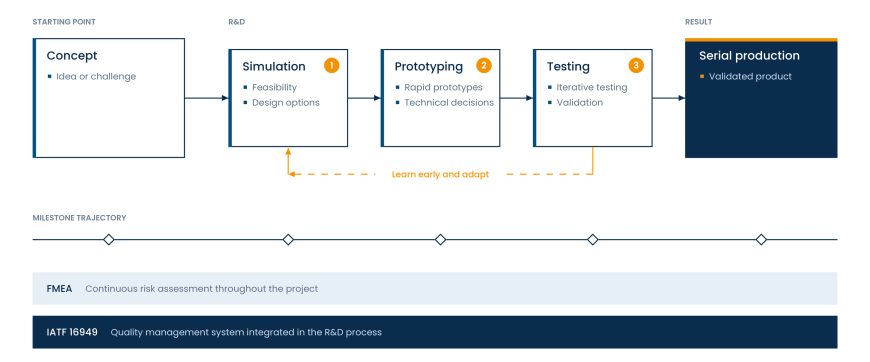
At NiniX Technologies, R&D follows a clear structure: an IATF 16949 quality management system, continuous FMEA (failure mode and effects analysis) and a clearly defined milestone trajectory. This creates clarity in the early stages of a project, so development can progress on a strong technical foundation.

1. Technical feasibility

We explore whether a concept can be realised technically, and identify the main risks before significant time and budget are committed.

2. Design options

Different design options are evaluated against the technical requirements, so the most suitable solution is chosen on objective grounds.

3. Prototypes

Prototypes are built to validate technical decisions in practice, allowing us to learn early and adapt quickly.

4. Validation for serial production

The end product is validated for serial production, so the step from development to manufacturing is predictable.

From exploration to acceleration

One of the main challenges in innovation is the gap between concept and execution. R&D bridges this gap through technical insight, simulation, and testing and validation.

Through close collaboration with our customers and with knowledge institutes, combined with rapid prototyping, iterative testing and continuous validation, we enable faster decision-making. Instead of long development cycles based on assumptions, we focus on learning early in the process and adapting quickly. This significantly reduces the risk of late-stage redesigns and allows projects to move forward more efficiently.

Integrating R&D with product development and production

R&D does not operate in isolation. Accelerating innovation requires close alignment between product and process development, with a clear focus on future serial production.

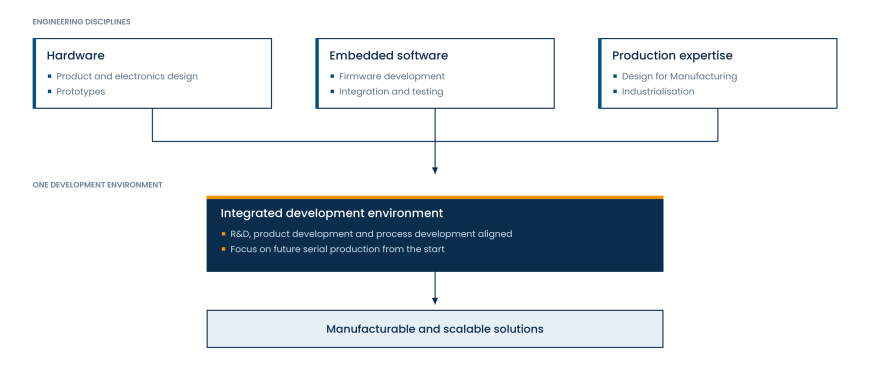
That is why we have fully integrated our engineering teams, bringing together hardware, embedded software and production expertise within the same development environment. This ensures that solutions explored during R&D are not only technically viable, but also manufacturable and scalable.

By linking R&D, product development and Design for Manufacturing, we create a continuous flow from idea to product.

Looking to accelerate your innovation?

Want to reduce uncertainty and validate your concept? Contact our specialists to discuss your project.

Frequently asked questions

Structured R&D identifies technical risks early, validates feasibility and defines a clear path from concept to production. This prevents delays, unpredictable outcomes and costly redesigns later in the project.

NiniX integrates FMEA throughout a clearly defined milestone trajectory and applies an IATF 16949 quality management system in its R&D process.

The process includes exploring technical feasibility, evaluating design options, building prototypes to validate technical decisions, and validating the end product for serial production.

Hardware, embedded software and production expertise are combined in one development environment, and R&D is linked with product development and Design for Manufacturing from the start.