Image

Embedded Software Development for Connected Devices
Embedded software: connecting hardware to real-world systems

Embedded software turns electronic hardware into an intelligent, connected system. In this article, we explain what embedded software is, which functions it performs, and how NiniX Technologies develops embedded software that integrates new hardware into existing machines and infrastructure.

What is embedded software?

Embedded software enables a device to convert analog or digital signals into data, process that data and communicate information in real time. Unlike traditional software applications, embedded software is designed for specific hardware platforms and operating environments. It often runs under strict constraints, such as limited memory, real-time requirements and demanding reliability standards.

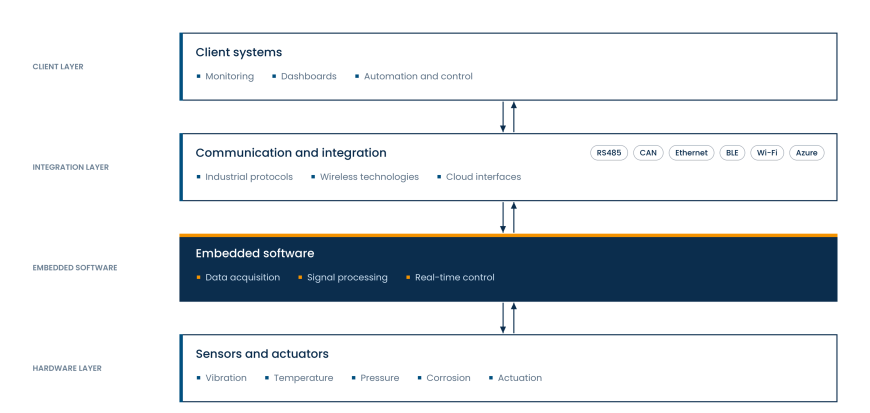
In many modern systems, embedded software forms the link between physical hardware and higher-level digital infrastructure. Sensors collect data, embedded software processes it, and communication interfaces transmit the results to other machines, cloud platforms or monitoring systems.

Embedded software at NiniX Technologies

At NiniX Technologies, embedded software plays a central role in our solutions. It forms the bridge between new hardware developments and our clients' existing infrastructure, so that new devices become a seamless extension of existing systems rather than isolated products.

1. Measuring and processing data

Sensor data covers physical parameters such as vibration, temperature, pressure and corrosion. Our embedded software handles data acquisition and signal processing directly on the device, including filtering, anomaly detection and preparing datasets for machine learning or predictive maintenance.

2. Transmitting data reliably

We enable communication through a wide range of industrial protocols and technologies, including RS485, CAN and Ethernet, as well as Bluetooth Low Energy (BLE) and Wi-Fi. Through our partnership with knowledge centres such as imec, we can also set up proprietary communication networks for more demanding environments.

3. Integrating with existing platforms

The goal is not only to collect data, but to integrate it into the systems clients already rely on. Our embedded software connects directly to cloud platforms such as Microsoft Azure, and to client-specific frameworks already implemented in their machines or operational infrastructure.

4. Enabling control through client frameworks

Embedded devices can also execute actions. By integrating with machine and automation frameworks, they can control motors, actuate mechanical components or trigger automated processes, based on measured parameters or incoming commands.

The bridge between hardware and infrastructure

In product development, hardware and software cannot be treated as separate disciplines. Sensors, electronics, communication protocols and backend platforms must work together as one integrated system.

At NiniX Technologies, embedded software is developed alongside the hardware from the start of the project. This close integration ensures optimal performance, reliable communication and smooth integration into the client's operational environment. Because data is processed directly on the device, monitoring remains efficient and reliable, even in demanding environments.

The result is more than a product: it is a connected system that generates insight, supports decision-making and enables smarter operations. Read more about our integrated engineering approach in our article on R&D as a driver for accelerating innovation.

Planning to develop an embedded system?

Exploring how embedded systems could support your product or infrastructure? Contact our specialists, from concept and development to full system integration.

Frequently asked questions

Embedded software is software designed for a specific hardware platform. It converts signals into data, processes that data and communicates it in real time, often under constraints such as limited memory and strict reliability requirements.

NiniX supports wired protocols such as RS485, CAN and Ethernet, and wireless technologies such as Bluetooth Low Energy (BLE) and Wi-Fi. Proprietary communication networks can also be developed in partnership with knowledge centres such as imec.

Yes. NiniX develops embedded software that connects directly to cloud platforms such as Microsoft Azure, as well as to client-specific frameworks.

Developing both from the start ensures optimal performance, reliable communication and smooth integration into the client's existing systems.