Image

Design for Manufacturing (DfM) in Product Development
Design for Manufacturing: from product idea to scalable production

Many companies know what they want to build, but not yet the most efficient way to manufacture it. In this article, we explain what Design for Manufacturing (DfM) is, how NiniX Technologies applies it from the very first concept, and why it leads to predictable costs, reliable quality and a faster route to market.

What is Design for Manufacturing?

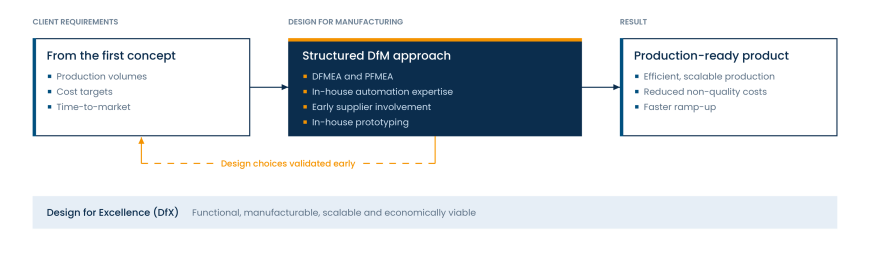
Design for Manufacturing (DfM) is a structured methodology that NiniX Technologies applies from the very first concept in every product development project. Together with our clients, we set clear expectations and align the product requirements with the expected production volumes, cost targets and time-to-market goals.

DfM is part of a broader Design for Excellence (DfX) approach. It ensures that a product is not only functional, but also manufacturable, scalable and economically viable. Every decision in the product design is therefore evaluated for its impact on production, testing and long-term reliability.

Bridging the gap between concept and scalable manufacturing

Many clients come to us with a product idea, but without a clear roadmap to efficient manufacturing. By combining DfM, innovation control tools, automation expertise and supplier collaboration, we guide the product from concept to scalable production.

Innovation control with DFMEA and PFMEA

Design Failure Mode and Effects Analysis (DFMEA) and Process Failure Mode and Effects Analysis (PFMEA) allow us to systematically identify risks, failure modes and inefficiencies in the first stages of a project, before they reach production. This significantly reduces redesigns, delays and unforeseen costs.

In-house automation and machine building

A key strength of NiniX Technologies is our in-house automation and machine-building division. Its practical experience with assembly line systems is integrated directly into product development, so design choices are validated against real manufacturing constraints and opportunities, enabling a faster production ramp-up.

Early supplier involvement

DfM is inherently collaborative. We involve key suppliers early in the process to align component selection and availability, avoiding surprises when production starts.

In-house prototyping

We validate the mechanical design through rapid in-house prototyping. Aligning assembly and manufacturability at this early stage reduces late-stage changes and supports a smooth transition from prototype to production.

What DfM means for our clients

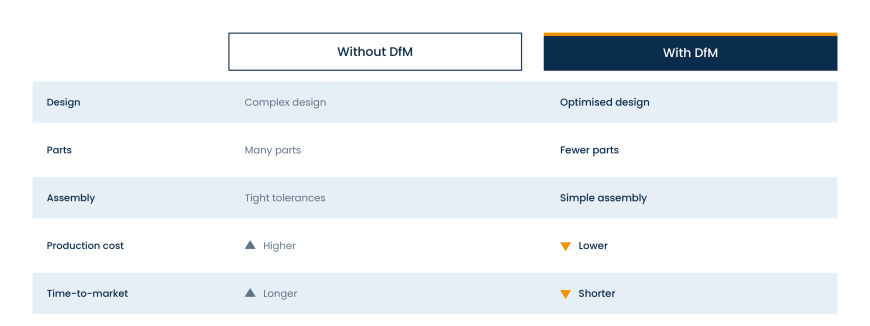
Without DfM, products often end up with complex designs, many parts and tight tolerances, which drive up production costs and delay the market launch. With DfM, the design is optimised for production from the start: fewer parts, simpler assembly, lower costs and a shorter time-to-market.

For our clients, DfM means predictable outcomes: controlled costs, reliable quality and a smooth transition from product development to market. This ensures that innovation does not stop at a prototype, but continues all the way to commercialisation.

Our clients often know what they want to build, but not yet the most efficient way to manufacture it. That is where NiniX Technologies adds value: by setting clear specifications, guiding the process and enabling an efficient and scalable production flow.

Harold Haspeslagh
Former Innovation Director at NiniX Technologies

From product idea to efficient production

Have a product idea and want to make sure it can be produced efficiently? Contact our specialists to discuss your project.

Frequently asked questions

Design for Manufacturing is a structured methodology that ensures a product is designed to be manufacturable, scalable and economically viable, by aligning the product requirements with production volumes, cost targets and time-to-market from the very first concept.

DfM focuses on manufacturability. It is part of the broader Design for Excellence (DfX) approach, which also considers aspects such as testing and long-term reliability.

DFMEA and PFMEA systematically identify potential risks, failure modes and inefficiencies in the design and in the production process, early in the project, before they lead to redesigns, delays or unforeseen costs.

DfM leads to fewer parts, simpler assembly, lower production costs, reduced non-quality costs, a faster production ramp-up and a shorter time-to-market.