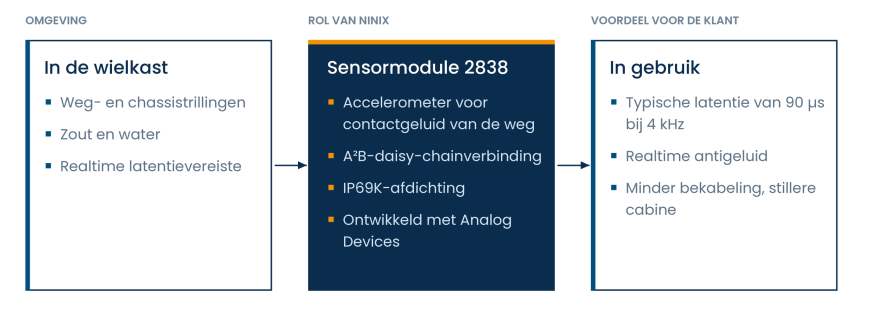
NiniX Technologies developed the 2838 sensor module for active road noise cancellation (ARNC), in close cooperation with Analog Devices. The module registers chassis vibrations and structure-borne road noise in real time and transfers the data over the A²B bus, so the vehicle can generate anti-noise and reduce tyre and road noise in the cabin.
Latency requirements for road noise cancellation
In active road noise cancellation, the vehicle audio system generates a sound wave in antiphase with the incoming road noise. This only works if the vibrations that cause the noise are measured and processed almost instantly: any delay between measurement and counter-sound reduces the cancellation effect. The sensors are mounted close to the wheel arches, where they are also exposed to vibration, salt and water.
Accelerometer-based sensing over the A²B bus
The 2838 module uses an accelerometer to register chassis vibrations and structure-borne road noise. Several modules are daisy-chained over the A²B (Automotive Audio Bus), a digital bus designed for low-latency audio and sensor data in vehicles. Daisy-chaining reduces the cabling across the system and lowers cabling costs.
An IP69K sealing technique protects the electronics against vibration, salt and water in the wheel arch environment.
Real-time anti-noise with a typical latency of 90 µs
With a typical latency of 90 µs at a bandwidth of 4 kHz, the vehicle computer receives the vibration data in time to generate the anti-noise in real time, reducing tyre and road noise in the cabin. The design is modular and can be adapted to specific vehicle requirements.