Sensor for structural health monitoring of hydrogen tanks
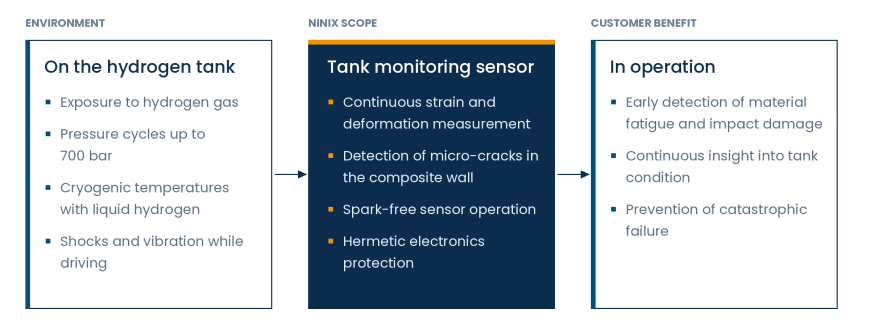
NiniX Technologies developed a sensor for structural health monitoring of hydrogen tanks. The sensor continuously monitors mechanical stress, deformation and micro-cracks in the composite wall of the tank. Material fatigue or impact damage after a collision is detected at an early stage, before it can lead to catastrophic failure.
Measuring on a hydrogen system
The sensor has to operate in the conditions of a hydrogen system on a vehicle. It is exposed to the hydrogen gas itself, to extreme pressure cycles of up to 700 bar, to cryogenic temperatures in systems with liquid hydrogen, and to constant mechanical shocks while driving.
Because hydrogen is highly flammable, the sensor elements must also operate completely spark-free.
Continuous monitoring of the composite wall
The sensor monitors the tank wall in real time and measures three parameters.
Mechanical stress
Continuous measurement of the stress in the composite tank wall during filling, use and pressure cycles.
Deformation
Changes in the shape of the tank wall are tracked over time.
Micro-cracks
Small cracks in the composite material are detected before they grow into structural damage.
Hermetic protection
Advanced electronics protection, such as high-performance encapsulation or a glass coating, keeps the sensor elements sealed from the hydrogen environment.
Spark-free operation
The protection and sensor design ensure that the electronics cannot become an ignition source.
Early detection, before failure
Structural wear of the material and impact damage after a collision become visible at an early stage. The condition of the tank is known continuously, so damage can be acted on before it leads to failure.
KEY FACTS
Application
Structural health monitoring of composite hydrogen tanks
Measured parameters
Mechanical stress, deformation, micro-cracks
Environment
Hydrogen gas, pressure cycles up to 700 bar, cryogenic temperatures, mechanical shocks
Protection
Spark-free operation, hermetic encapsulation or glass coating
NiniX scope
Sensor development
WORKING ON SAFETY-CRITICAL SENSING IN A DEMANDING ENVIRONMENT?
Contact our specialists to discuss your application.